Showing posts with label Kurt. Show all posts

Thursday, 24 September 2015

Comment: How to see the Romans in Ravenglass!


(Photo by Rowan May)

Now that the project is nearly complete, there are several new Roman attractions visitors can see in Ravenglass ...

There is a new interpretation board next to the Roman Baths, in addition to those installed by English Heritage:


And there is a display in the Pennington Hotel, which means the display free to all, and open when the hotel is:


In addition, at the Ravenglass & Eskdale Steam Railway (aka La'al Ratty) there will also be a small selection of the Roman finds collected by local people over the years.

Appearing not just in Ravenglass, the dig report is currently receiving final touches and will be available to download soon.

Monday, 21 September 2015

Conference: Lake District Annual Archaeology Conference (with Romans in Ravenglass)


Date: Sunday 11 October 2015
Location: The Theatre by the Lake, Keswick
Cost: £13.50 (with tea and coffee), £19.75 (with tea, coffee and lunch)

This year the conference will provide an opportunity to learn about recent projects carried out in partnership with local communities and volunteers both within and closely adjacent to the National Park. Many of these have been supported by the Heritage Lottery Fund. Romans in Ravenglass Site Director Kurt will be speaking at 3.15pm.


For further details see: http://www.lakedistrict.gov.uk/learning/archaeologyhistory/archaeologyconference

For booking form see:  http://www.lakedistrict.gov.uk/__data/assets/pdf_file/0006/613779/Conference-Flyer-2015.pdf

Friday, 13 February 2015

Conference: Roman Castleshaw Archaeology Day, 21st March 2015


Ravenglass Dig Director Kurt will be speaking about the Ravenglass excavations at this conference in Uppermill, Saddleworth, near Oldham. Kurt has a previous connection with Castleshaw as he was a supervisor on the Manpower Services Commission sponsored excavations there in the 1980s. He's looking forward to seeing some familiar faces.

Also on the programme are a number of other Cumbrian Roman digs:


For details on how to book click here.

Thursday, 2 October 2014

Comment: The end of the digging season, but ...

And sheep shall safely graze

Now the sheep can roam the fields unhindered by archaeology trenches. The last digging season has finished, but there's plenty to come yet! Look out for Director Kurt's final week's digging report and Finds Officer Sandra's focus on artefacts in the next few weeks, and much, much more in the coming months.

Sandra
Finds Officer, Romans in Ravenglass

Tuesday, 26 August 2014

Comment: Not long now!


Hot off the press, it's the dig's 2014 tshirt!  Those who have already ordered theirs from ZikZak, should receive them soon.

Now it feels like the dig is really happening! Serious packing has begun here in York - we're tracking down and sorting out equipment, making sure we have paperwork, and everything else we need for a month's stay in Ravenglass.

The core digging team is the same as last year - Kurt is directing, Bryan and Rowan are supervising, and I will be lurking in the finds hut again. There will be changes in the staffing for the environmental sampling and fieldwalking, plus the addition of a Community Archaeologist on the open days to supervise the new Trench 4. There'll be more details in a later blog.

By this time next week in Ravenglass, the cabins will have arrived to form the compound. After picking up Rowan from ArcHeritage in Sheffield, and calling in at YAT in York to pick up the digging equipment, a big van will have arrived and been unpacked.

The team will be assembled and looking forward to another intensive and exciting excavation in the vicus at Ravenglass - see you soon!

Saturday, 7 June 2014

Report: Project Results Evening, 3rd June

There was a great line up of talks about the results from 2013's Romans in Ravenglass digging season.  Also promised was a preview of plans for the  2014's excavations  ...

Finds Viewing
First up, as from 6.30pm, was the Finds Viewing. In fact, some people were so keen, that they arrived well before the advertised time, and the finds were still being unpacked!  Sandra and Kurt fielded lots of questions, and even got to view some pottery brought in by a local collector.


By 7pm, when the talks were about to begin, the Old Laundry at Muncaster Castle was pretty much packed!  There were new faces, as well veterans from 2013.


Introductions
When everyone was settled, an introduction was given by Peter Frost-Pennington of Muncaster Castle who is the managing director of the land the excavations are on. He was looking forward to hearing about the results and the forthcoming season.

Holly spoke briefly about the upcoming showing of Romans in Ravenglass film and thanked the community for their participation in the project so far.
 The various versions of the Romans in Ravenglass film can be found here.


The excavations
After this, Kurt spoke about the results of last year's dig, which included an overview of the trench results (see Trench 1, Trench 2 and Trench 3 reports), and also the extensive Geophyscial survey. For 2014 Kurt told us about new Trench 4 to be used for schools and open days, giving the opportunity for schools (when they visit with Lisa) and visitors (on the Open Days) to have a go at digging. In addition, there are plans to have volunteer placements on site and helping on finds. These are for people with some experience who will have the opportunity to go into either site or finds work more deeply and have more responsibility. They will have longer stretches of time doing site or finds work. Further details will appear here and on the Lake District website soon.

The site will be open from Wednesday to Sunday, a change from the previous year. Sunday will allow those who work elsewhere during the week to have a choice of days to come to site, as well as allowing more weekend visitors to look round the excavations.

Outreach
Lisa then told the audience about the Outreach programme, which allowed several local schools to have a fun time learning about the Romans and digging in the classroom as well as on site.  In 2014 there will be three more site Open Days on the 12th, 13th and 27th September, as well as more schools visiting, along with the local Young Archaeologists' Club and Lake District Young Rangers. 


Last year, day-to-day site tours were run by dig stalwarts Leo and Brian, who managed to cover most days throughout the four weeks, and along with others as visitor numbers went up later on in the season. Visitor Experience Guides are now needed this season to spread the word about the background to the project and show the public and passers by around the site, and those interested will need to attend a training session on  August 9th - see further details here. The Romans in Ravenglass project finds will also be on display at the Living History Festival 24th-25th August at Muncaster Castle, and volunteers are needed for this event.

Sign up
The signing up forms for the 2014 season can be found on the Lake District's Roman in Ravenglass webpage.

After a short session of questions, the evening ended with people enthused and ready for the next season of excavations in September!

Tuesday, 11 March 2014

Report: What did geophysics ever do for us? by Director Kurt

Figure I: 3D magnetometer survey of the fort east of the railway line, looking west (the bath house is the small block bottom right). The east rampart and gate are clearly visible (bottom left), also the north rampart and the gully forming the north ditch. A street runs from the east to the square headquarters building (top middle). On either side of the street are pairs of barrack blocks running left to right across the width of the fort.

One of the major elements of the fieldwork in the 2013 season was the geophysical survey, which was carried out by Geophysical Surveys of Bradford (GSB). They provided training to a number of the volunteers, and at the same time managed to carry out a magnetometer survey of the fort and bath house as well as a large part of the surrounding area, some 35 hectares (86 acres) overall. Resistivity survey was also undertaken in certain areas, totalling about 5 hectares (12 acres). One aim of the work was to check the results of the original magnetometer survey by Birgit Kaspar of the University of Birmingham in 2011, which has identified possible Roman features east of the fort, but we wanted to investigate as wide an area of possible Roman settlement as possible, north and south of the fort was well as to the east. In addition, we wanted to investigate the fort and bath house, which had never been subjected to geophysical survey. So what did we find?
Figure II: Main magnetometer survey, north to top. The fort is bottom left (area 8). Area 7 is part of the vicus along the north coast road. The vicus east of the fort (lower middle) appears as a mass of features, mostly rectangular buildings. The Hardknott road (upper centre to top right). Features on either side of the road (upper centre) indicate more roadside settlement, which tails off as the road leads away from the fort. The heavy, dotted linear features with white edges are modern pipes.

One main result was to confirm that there did indeed appear to be evidence for a vicus to the east of the fort, extending in a broad area for about 150m east of the fort. This eastern vicus is characterised by rectangular features which was interpreted as ‘strip buildings’; these usually take the form of long, narrow timber buildings on stone footings, which lie end-on to the streets in order to maximise the number of properties that have access to the street frontage and therefore the commercial action. Even the southern part of the ‘eastern vicus’ seemed to comprise these strip buildings. This finding is contrary to the original survey, which suggested there were more scattered features in this area; the revised interpretation is supported by the results from Trench 3. There is some evidence from the limited surveys north of the fort that there are buildings, probably a part of the vicus fronting on to the main road north to Maryport and Hadrian’s Wall. However, there is no evidence of a vicus south of the fort.

The buildings north-east of the fort are aligned on a main road running east-north-east; this is supported by the evidence from Trench 1. The resistance survey provides a good view of the road, with several side streets running off it. The latest surveys indicate that this road continues up the slope and through a shallow valley on to the higher ground, and so is almost certainly the main Roman road from Ravenglass to Ambleside fort via Hardknott.
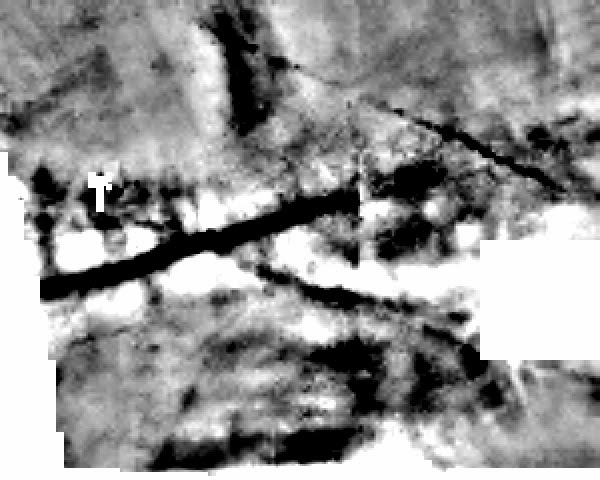
Figure III: Resistivity survey, detail of the Hardknott road, north to top. The road appears clearly as a dark linear feature (middle left to top right), with short side streets. The buildings and floor deposits of the roadside buildings are indicated by the white strips on either side of the road. The two linear features aligned north-west to south-east indicate a different phase of activity, possibly earlier than the road and vicus.

The orientation of the buildings in the eastern vicus is very interesting. In contrast to the east-north-east road observed in Trench 1, the buildings in the southern part (identified in Trench 3) appear to be aligned north-south, which suggests they front on to a street running west-east. Although not as clear as the road to Hardknott, there is a linear feature on the magnetometer survey which may well represent a road running from the east gate of the fort due east for about 200m before turning south-east. Could this be the main road to the south, having to take a detour to avoid a ravine that would have been a major obstruction to a road exiting the south gate? This would explain the absence of a vicus south of the fort. The alignment of the buildings in the central part of the eastern vicus (being investigated in Trench 2) are on yet another aligment, indicating that they respect a minor street running north-east from the fort.

There are numerous other features in and around the vicus, which will require further investigation to determine whether they are Roman in date. However one feature of note is that immediately south of the modern boundary separating the two fields that form the major part of the fieldwork, which appears to be aligned on the bath house. There is evidence that a lead pipe which would have fed water from the high ground to the east down to the bath house was unearthed in the recent past; perhaps this is part of that pipe.

The bath house results are not distinct and suggest much disturbance from the 19th century excavations. However, the results from the fort are more useful. The buildings closest to the railway line appear to be the administrative range, with the principia or headquarters building in the middle. The eastern part of the fort appears to contain buildings aligned north-south, probably two pairs of barrack blocks.
 
The geophysical survey results have provided a wealth of information that has greatly aided the interpretation of Roman Ravenglass. The work has raised as many questions as it has answered but that is typical of archaeological research!

Wednesday, 27 November 2013

Comment: Romans in Ravenglass video now live!


I’m pleased to say that the Romans in Ravenglass video is now available to view on the Lake District National Park website. Just click here to view.

The 5 minute version is a cut down version of the 13.40 minute one which is well worth watching. It gives a really good impression of the dig and what all your hard work achieved. If you are lucky you might even see yourself in the video!!


Sunday, 10 November 2013

Report: Lake District Archaeology Conference, 3rd November

The Lakeside Theatre in Keswick was pretty much sold out for the conference about this year's Lake District archaeology.
 The whole emphasis of the conference was community archaeology. With the formation of the Archaeology Network, the Lake District knows it has a wonderful volunteer resource for helping out with various projects within the National Park.  Added to that, there are several projects (for further information, see this newsletter) funded by the Heritage Lottery, as well as other other types of funding.  All would not take place if it were not for volunteers from the local community.

There are currently three Roman vici or settlement projects going on in the area!  There was Papcastle, Maryport and of course Ravenglass. So it was intreresting to hear about the various findings of these three sites, and someone commented that there would doubtless be a monograph on Roman Settlements in Cumbria appearing in the next few years.

The conference saw the first showing of Romans in Ravenglass - the film!  The version we saw was around five minutes long, and featured some now well known faces, including Holly, Kurt, Brian K, Leo, and Peter Frost-Pennington, as well as some of the diggers talking about their experiences. This version is due to be uploaded to the Lake District website shortly.  There is also a longer version of the film, which will hopefully be shown at the community presentation next year.

Ravenglass Director Kurt came over from York for the day to talk about the Dig.  Having only very recently got hold of the Geophys results, he was able to provide additional information with regards to the Roman roads, but said there is much more to come (this will be the subject of a future blog).
 It was also a chance to catch up with some of the Romans in Ravenglass volunteers!  It was great to meet up and exchange news.

Overall, it was an interesting and informative day, which gave a great insight to the work being done under the auspices of the Lake District National Park, as well as further Roman sites in the area.

Wednesday, 16 October 2013

Report: 30th September


All the digging had stopped, and now the packing started in earnest.   The first cabin to go was the Welfare Unit.   Meanwhile, the trenches were being backfilled:


The Finds Officer took the opportunity for a couple of snaps of the finds before they were packed away in their boxes:

This is the colour-coated folded beaker that was found during the last week of the dig.  It has a buff fabric, but a grey-brown slip over it, which may be trying to imitate a metal such as pewter.

Ironically on the first Saturday of the dig, there was a Potter at the Pennington Arms, showing how he made made reproduction Roman pots. One of the pots on show was a folded beaker, laying on its side - these pots tended to have small bases, so were top heavy:


Eventually, the finds were all packed up ready for the van that was to arrive mid-afternoon:


Then it was a case of taking down the fencing and waiting for the van:


By around 5pm, we were all packed up and ready to return to Yorkshire.


We're now looking forward to the 2014 season of Romans in Ravenglass!

Digger's view: Early one morning ...

On the last day of digging (28/9/13), Bryan, Kurt, Rowan and Sandra got into site, got set up, and then waited for the diggers to arrive.  Over their tea and coffee, Rowan, Kurt and Bryan discussed the strategy for the day.  Meanwhile, the Finds Officer went on the prowl with her phone camera ...


Thursday, 10 October 2013

Report: By Director Kurt - What did we find in Trench 1?


From an early stage, the gravel surface at the south end of the trench and the alignments of large stone blocks in the middle of the trench seemed good candidates for the Roman street with timber building to one side that were indicated on the 2011 geophysical survey. However, the stony layer overlying the building contained post-medieval as well as Roman pottery, and the use of such large, if not massive, stones as a foundation was in contrast with the foundations evident in Trenches 2 and 3. Overall, this left a nagging doubt that we were dealing with a relatively recent building that happened to follow the Roman alignment.

However, two further layers of rubble, with distinct dumps (barrowloads?) of cobbles, stone and shale fragments contained only Roman pottery. Furthermore, similar deposits appear to continue beneath the building, which suggests that infilling of the ditch as its fills settled had been a long process. The current interpretation is that the massive blocks are the foundations for a timber building, perhaps of two storeys, with the rubble forming a bed for earth floors that have been removed by ploughing.

Although it is assumed the building extended to the edge of the street as is usually the case, the massive blocks as found were restricted to the rear part. It is suspected that the blocks had subsided into the fills of a large east-west ditch that became disused before the building was constructed. The blocks (and associated rubble layers) appear to have been an unsuccessful attempt to form a solid base for the building on the unstable ground. The front of the building, on firmer ground, may have had much slighter footings or even been built with earth-fast posts, and we hope to find evidence of this next year. 

An alternative theory is that large stone blocks also formed the foundation of the front of the building. If so, as these blocks would not have settled into the ditch they would have obstructed ploughing, and may even have protruded above the ground surface. Consequently they would have been removed, presumably for re-use elsewhere. If so, we will find only a gap in the building construction marking the absent stones. Either way, there is the exciting possibility of finding a large ditch beneath the building next year.

Monday, 7 October 2013

Event: Lake District Archaeology Conference 2013 - 3rd November

A day conference at The Theatre by the Lake, Keswick

Sunday 3 November 2013

The Lake District is a unique combination of natural landscape modified by millenia of human activity. During this conference, learn about recent projects carried out by local groups, individuals and organisations, including the National Trust.

Programme

10.00 Introduction

Vivienne Rees, Chair of Historic Environment Advisory Group, Lake District National Park Authority

10.05 Archaeology in the Lake District National Park 2012-13

John Hodgson, Lake District National Park Authority

10.15 Reflections on History – survey and investigation of slate quarrying in Great Langdale and early mining near Grasmere

Jamie Quartermaine, Oxford Archaeology North and Jamie Lund, National Trust

11.10 Questions and Discussion

11.15 Coffee/tea

11.45 Survey of long houses in the Duddon Valley

Peter Matthiessen, Duddon Valley Local History Group

12.05 Recent work of the Cumbria Amenity Trust Mining History Society

Warren Allison, CATHMS

12.25 Geophysical survey and excavation of the Roman vicus at Ravenglass

Kurt Hunter-Mann, York Archaeological Trust

12.55 Questions and Discussion

1.00 Lunch

2.00 Geophysical survey of the Roman fort and vicus at Ambleside

Jamie Lund, National Trust

2.10 The Roman settlement project at Maryport

Stephen Rowland, Oxford Archaeology North

2.45 Coffee/tea

3.10 Discovering Derventio: recent archaeological investigation of the Roman site at Papcastle

Frank Giecco, Wardell Armstrong Archaeology

3.50 Questions and Discussion

4.00 Finish

How much is it?

Conference including tea and coffee: £13 each
Conference including tea, coffee and buffet lunch: £19.25 each
If you require a parking voucher please add £2

How to book

Please fill in the Archaeology Conference Form (PDF) and send a cheque for the appropriate amount (payable to LDNPA) to:
LDNPA
Murley Moss
Oxenholme Road
KENDAL LA9 7RL
Alternatively call 01539 724555 with your debit or credit card details.

Closing date

The conference normally sells out, so please don't wait too long! The final date for bookings is Monday 28 October 2013.

Parking

There is a pay and display car park next to the Theatre. There is a discount for parking on any long stay car park in Keswick with Allerdale Borough Council. A day rate of £2 is payable only in advance.
Please tick the box on the form and add £2 to your payment if you need a parking voucher.

Details also at:  http://www.lakedistrict.gov.uk/learning/lakedistrictfacts/archaeologyhistory/archaeologyconference

Sunday, 6 October 2013

Event: Hadrian's Wall Archaeology Forum - 19th October


Tickets can be purchased online at: http://purchase.tickets.com/buy/TicketPurchase

Although Ravenglass Director Kurt may well be attending this meeting, he will not be giving a talk on the Romans in Ravenglass dig this year.  It's too early to have had time to get all the information (site, geophys, fieldwalking, finds, etc.) together given we only finished digging on 28th September, but Kurt will be speaking at next year's Forum.

Monday, 30 September 2013

Report: 26th-28th September 2013

The last few days on site were very busy, hence the lack of blogging :D  As well as hosting another day of School Visits, we also had the BBC visit us on Friday, along with the usual film crew also getting those last few shots for their film for the Lake District. 

BBC North West interviewed people on site, as well as taking film of the finds. Unfortunately, there isn't a link to the Look North programme on the BBC website, so those who actually saw it can count themselves as lucky!

The BBC cameraman went to great lengths to get a good shot of the Samian 'Venus' sherd, which is rather tiny, but she *did* appear on the tv!

Furious packing up of washed finds took place on the Saturday, and fortunately the weather stayed fine so there was plenty of room to sort them all out!  A big thank you to Janice who undertook this mammoth task!

Maggie kindly washed the door pivot stone which finally made its way to the Finds Hut.

And here it is, nice and clean.  It's possible to see the 'fault' line on the top right, which would have ruled it out of being a quernstone.

Then it was time for the final Finds Talk and the Final Site Tour of the season and there was a very good turnout out, including the Muncaster Estate owners Peter and Iona Frost Pennington:


Director Kurt's thoughts on the dig so far will be included in a future blog!